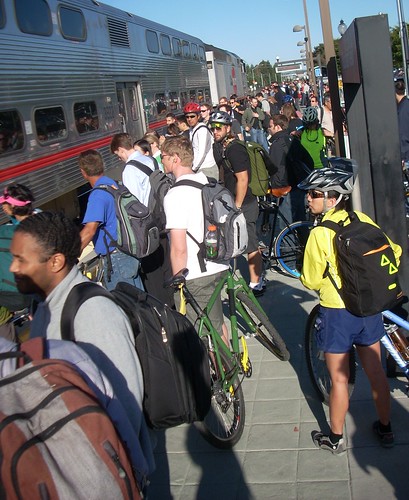
Starting last month, there has been a dispute between bicyclists and NJ Transit. The dispute is over the NJ Transit's policy that only allows cyclists to carry their bikes onto trains at stations with elevated platforms, including Hoboken Terminal. This is because the agency views people carrying their bikes at stations with ground or low-level platforms as creating a safety hazard for non-cycling rail passengers. In response, bicyclists have retaliated by claiming this rule inconveniences them since some areas lack high-level platforms. Of the 96 stations total, 60 are high-level stations without stairs. Cyclists are also upset that bikes are not allowed on trains during rush hours or holidays. They find this unjust since they may need both bike and rail for work or pleasure. Other non-bike rail passengers support the agency’s current policies for bicyclists because of bias/ideological issues (e.g. “bikes and rail do not mix”) or the perspective that “bicyclists are out of control first weaving between cars, then pushing people off sidewalks, and now wanting to push people off the platforms.”
The North Jersey Transportation Advisory Committee (NJTAC) has been charged to review the policy and offer recommendations to the NJ Dept. of Transportation Commissioner Jim Simpson and NJ Transit’s rail division’s Kevin O’Connor. I hope NJTAC will use a collaborative or conflict resolution process between the disputing parties (NJ Transit, Bicyclists, Non-Bike Rail Passengers) by using interest-based group negotiation facilitated by a neutral third-party mediator, who would come from the NJTA Advisory Committee. This is because NJ Transit and bike and non-bike rail passengers want to maintain a good relationship with each other since both are dependent of each other. The bike and non-bike rail passengers want the agency's respect. There is a shared interest among the three groups (they all like rail), a common purpose (bike rail passengers want policy removed; transit and non-bike rail passengers want policy maintained); shared identity (self-explanatory); and a degree of interdependence (NJ Transit needs fare revenue; passengers need to ride rail). Someone from the NJTAC who has knowledge and credibility between the bicyclists, non-bike rail passengers, and NJ Transit should act as the mediator.
Prior to negotiation, the mediator should individually meet with each party asking how they like to resolve the issue while being fair to the other parties involved, followed by asking each party’s BATNA is to the current NJ Transit policy, assess how realistic the best alternative to negotiated agreement (BATNA) is, and if each are satisfied or happy with it. Ground rules should be established for all parties. The parties should decide on the final outcome, not NJTAC. Easy, smaller items that can be agreed upon by all parties should be discussed first. If there are past resentment, it is best to address them during this stage.
Each party's position seem already known, but not every party’s interests are known. For this reason, the mediatior should seek to understand what their objectives are for their positions followed by determining how they want to decide on the final outcome and determine a basis for future intervention when necessary. The mediator should then ask NJ Transit to provide the past history and other information that led them to view carrying bikes at ground to low-level platforms as a danger to other passengers. There are two types of bicycles (standard-form and foldable), so the agency will need to clearly define what types of bikes are permitted for different level platforms or if they are all not permitted. He or she will ask cyclists who use rail where their origin and ultimate destination is. For the non-bike rail passengers, ideology (or bias against bicyclists) and past history of “out of control” bicyclists that may not reflect all bicyclists seem to affect their decision. Finally, the mediator should seek what they like to see NJ Transit do to ensure bicyclists are “controlled.” Any emotions based on past history or biases will be redirected to the discussion of what to do to move forward to resolve issue.
Some solutions that may work are: (1) forbidding bicyclists to ride their bikes on any station platform and give other passengers right-of-way due to their bikes; (2) educating both bicyclists and non-bicyclists that each must respect each other rather than “pushing” one party to another space that could create a safety hazard for both; (3) create a bike-designated area for bike-rail passengers on stations so other passengers know where to avoid waiting for the train; (4) have NJ Transit clarify the type of bikes that are permitted on stations and show proof bicyclists do endanger other waiting passengers at stations.


No comments:
Post a Comment